signalrev
aboutright for youhow it worksthe engagementfaqbuyer's guidearticles
menu
book a call

Your buyers don't buy what you build. They buy what they understand.

Most b2b software has features nobody outside the team can explain in one sentence. A founder writes the homepage in the language of the product. A buyer reads it in the language of their own problem. The two rarely match.

Every unclear word costs a click, a demo, a deal.

signalrev's Position work turns weeks of guessing into one written definition. Who buys. What they're actually buying. Why it beats doing nothing.

01 / what you get

what you get

01

A buyer definition.

Two people, not one: whoever does the work day to day, and whoever signs off on buying something to fix it. What each one owns, what they've already tried, what it would take for each to say yes.

02

A positioning statement.

One paragraph a stranger could repeat back correctly.

03

Proof points.

The specific evidence behind the claim, ready to hand to whoever writes the headline next.

02 / a sample, not a description

a sample, not a description

Most positioning work stays in someone's head or buried in a slide nobody opens again. Here's what a founder actually walks away with.

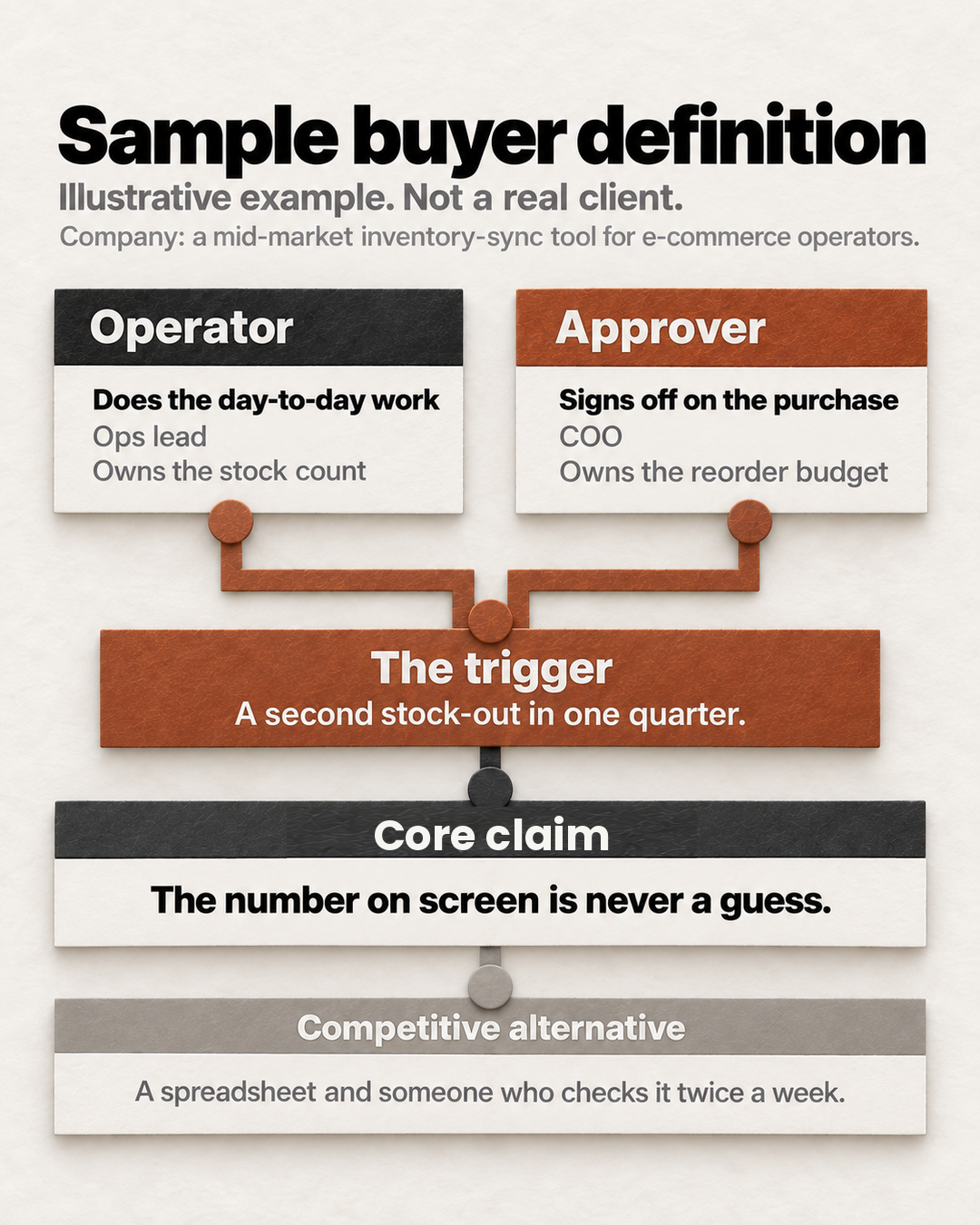
Sample buyer definition (illustrative example, not a real client)
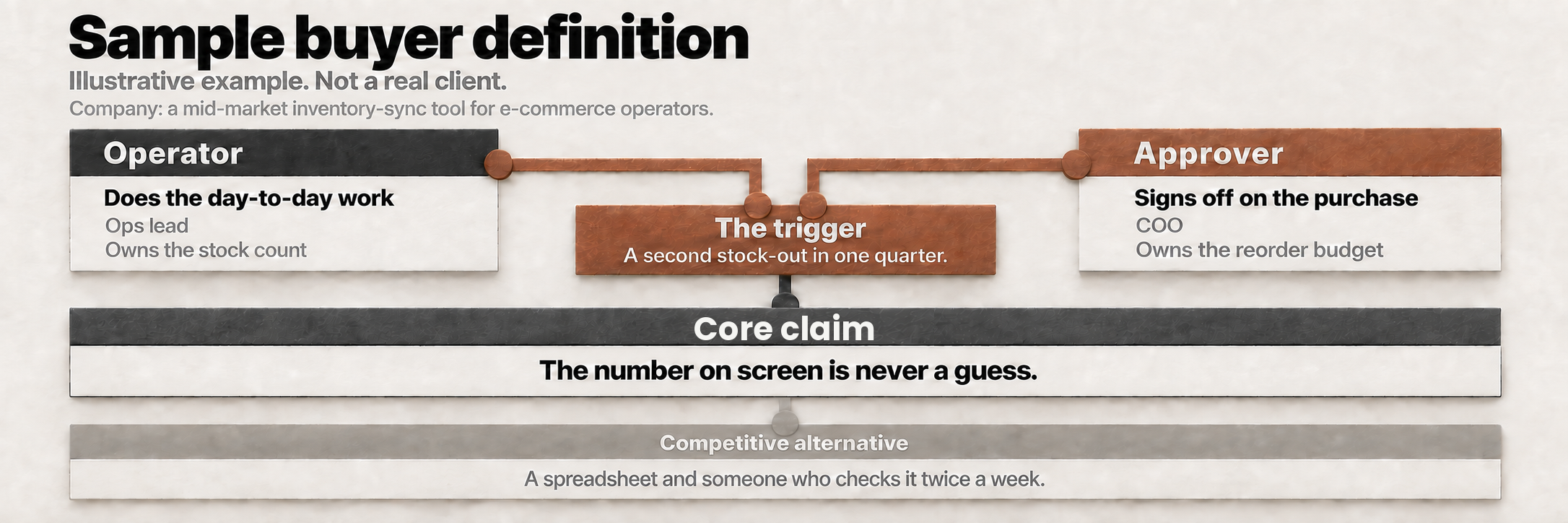
An operator and approver converge on the trigger, core claim and competitive alternative in a sample buyer definition.An operator and approver converge on the trigger, core claim and competitive alternative in a sample buyer definition.

Company: a mid-market inventory-sync tool for e-commerce operators.

Operator, does the day-to-day work: the ops lead. Owns the stock count. Measured on stock-outs per quarter. Loses hours reconciling three spreadsheets by hand. Already tried a monthly manual audit. It slipped after the second stock-out.

Approver, signs off on the purchase: the COO. Owns the reorder budget. Finance signs off above a set threshold. Needs the cost of the last stock-out in dollars before saying yes.

The trigger: a second stock-out in one quarter. The first one was a fluke. The second one is a pattern.

Core claim: for e-commerce ops leads who've been burned by a stock-out, [product] is the inventory system that closes the gap between the warehouse and the storefront. The number on screen is never a guess.

Competitive alternative: mostly, nothing. A spreadsheet and someone who checks it twice a week, until the check gets missed. [product] doesn't compete with a better spreadsheet. It competes with the belief that checking twice a week is enough.

03 / the test

the test

Written down, it's checkable. Anyone on the team can repeat it the same way a founder would.

Can your first sales hire explain what you sell, in the words a buyer would use? If not, that's the gap this closes.

04 / next step

book a call

see also: presence · inspection