How long does it take?
Position runs weekly by default, 5 to 8 weeks. Twice a week gets it done in about 3 weeks. Presence runs 5 to 7 weeks, then you run the 30, 60 and 90 day plan yourself. Inspection is weekly and runs 3 to 4 weeks. The weekly review is a separate block.
How do I know if I need positioning?
If buyers ask what you do after reading your site, if referrals describe you as something else, or if you pitch differently on every call, position is likely to help. If your message is already clear and buyers understand it, but you are not reaching enough of them, start with presence instead. We work out which on a 30 minute call.
More on this: The executive finally said the pitch back to us →What do I have at the end?
Position: a buyer definition, a positioning statement in one paragraph a stranger can repeat back, the customer results and stories that back the claim, four pages of website copy with wireframes for your web person to build from, and your LinkedIn headline and About section rewritten to match. Presence: a starting list of 10 accounts with the people to contact and the reason they might be in the market, five follow-up sequences, six posts, your LinkedIn profile, and a launch plan you run over the 30, 60 and 90 days after the engagement. Inspection: six gates that test each deal, from the buyer's problem to whether you can reach the person who says yes. If you add the weekly review: a weekly review protocol, stage-velocity flags, and your CRM pipeline stages and fields set to match the review.
What happens after the engagement?
What's yours when the engagement ends: everything built during the engagement. You can run all of it independently. The system doesn't depend on us. What you built stays in your accounts, and your next hire starts from it. Founders who want to keep the weekly review going afterward can, through optional ongoing support.
Nobody plateaus from a bad strategy. They plateau from a good one they stopped running. →Is this sales training?
It's coaching on your real pipeline, with a system left behind. No slides, no course modules, no frameworks taught in the abstract. You learn by working your actual pipeline with a system underneath you. Every session looks at real deals and real conversations. What happened and what to do differently. The founder who finishes has not completed a programme. They have built and run a revenue system, and they have got better at selling by using it.
Can I build this system myself without signalrev?
Yes. The tools are not proprietary and the approach is not a secret. The hard part is what you put into them, the positioning, the buyer map and the messaging that moves your buyers, and then running it on your own deals until it holds. signalrev compresses that from months of trial and error into 3 to 8 weeks per package.
VP of sales vs fractional CRO vs sales consultant, what does a seed-stage founder actually need?
Depends on what's missing, and many founders end up with one of them. A VP of Sales runs and grows a sales team. A fractional CRO brings senior judgement part time. A coach or consultant improves how you sell, and we do some of that too, on your real pipeline. Whichever you choose, they work faster from a written buyer definition and a weekly review than from what's in your head. That's the part we build.
How is this different from hiring a fractional CRO?
It isn't either-or. Plenty of founders at your stage use one, and a good one brings judgement you don't have. What they usually don't start with is why your customers buy you, or a weekly review you run yourself. We build those, so whoever you hire walks into something they can use.
The founder who took themselves out of the motion and growth didn't stall →Is signalrev right for me if I already have some sales process?
Possibly. If your process is inconsistent, or deals close but you cannot explain why, then yes. signalrev is most useful when there is real commercial activity to work with. If you are pre-revenue, get a few customers first. If you have a repeatable system that is performing well, you probably do not need it.
Does this work for services businesses, not just SaaS?
Yes. The fit is a founder-led B2B company of 5 to 100 people with a relationship-led sale, whether you sell software or services. What matters is whether a founder owns the revenue decision and needs a buyer definition, stage gates, and a weekly rhythm installed under it. High-volume or ecommerce-style selling is the one shape this doesn't fit.
Who is signalrev not for?
If you have no paying customers yet, want someone to run the pipeline for you, need outbound at volume, can't make a weekly decision, want a training course, or already have a sales leader running a working machine. Enterprise RevOps builds and custom CRM sprawl aren't in scope either.
What happens to my data?
Your data stays in your accounts, apart from recordings of our own calls and the working copies I hold while we work, and any call content I send through Claude for analysis. Your CRM and your other tools run on your own subscriptions, and I work in them with access you grant. When the engagement ends, I hand over everything I built, delete my copies within 30 days, and you remove my access. If you choose ongoing support, I keep only what that work needs, and delete it within 30 days of stopping. Our calls together are recorded in my own account. I delete those recordings within 30 days of the engagement ending, or sooner if you ask. I don't use your recordings or data to train AI models.
Are my calls recorded, and what do I tell people?
I record our calls together, so in position, what you say feeds your buyer definition, guide and writing skill. Recordings of your own sales calls are optional, and without them we work from your notes and your CRM. If you want them, I suggest a recorder in your own account. You choose it and run it, and I don't set it up. When I use AI to analyse recordings, it runs through Claude under my own paid account, with training on your data switched off. You make sure your buyers know a call is being recorded, under the rules that apply where you and they are. Some recorders appear on the call where everyone can see them. If yours doesn't, you say so at the start.
How is this different from a HubSpot partner?
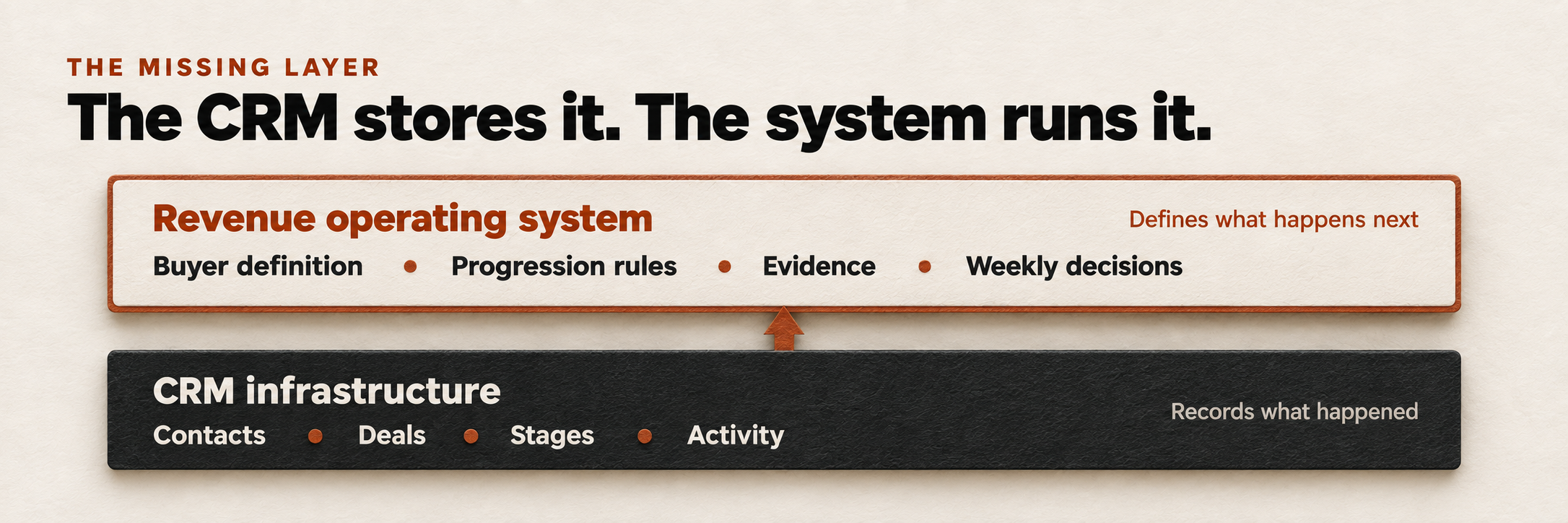
A HubSpot partner sets up the tool. We configure HubSpot too, but the tools are infrastructure, not the product. The thinking, your buyer definition, the message, the weekly review, is what a tooling partner does not build.
How is this different from LinkedIn help?
A ghostwriter keeps posting for you. We build the system and give you a way to read the signals, so it keeps running after we're gone.
How many hours a week from me?
Around each session, expect to prepare on your own deals and drafts. In inspection, most of the work is prep on your deals between calls. I tell you what is needed before each session.
What happens in a session?
A session is a working call on your real buyers, deals and drafts. I do the drafting and build work between sessions. Each written piece gets one round of revisions. I hand over the copy and you publish it on your site and LinkedIn.
Do you take equity or referral fees?
No, in either direction.